Registering where you live
Registering your address in Japan: Japanese for the ward office
You and Yoko are friends. You've just moved, and the address has to be registered within two weeks, so she's taken the morning off to come with you. She's already pulled a numbered ticket. Yoko speaks first, in polite Japanese: です and ます, the way people talk with strangers, neighbors, and coworkers. Here is how it can begin, and the phrases and words worth having ready.
politeWith Yoko, at the ward office
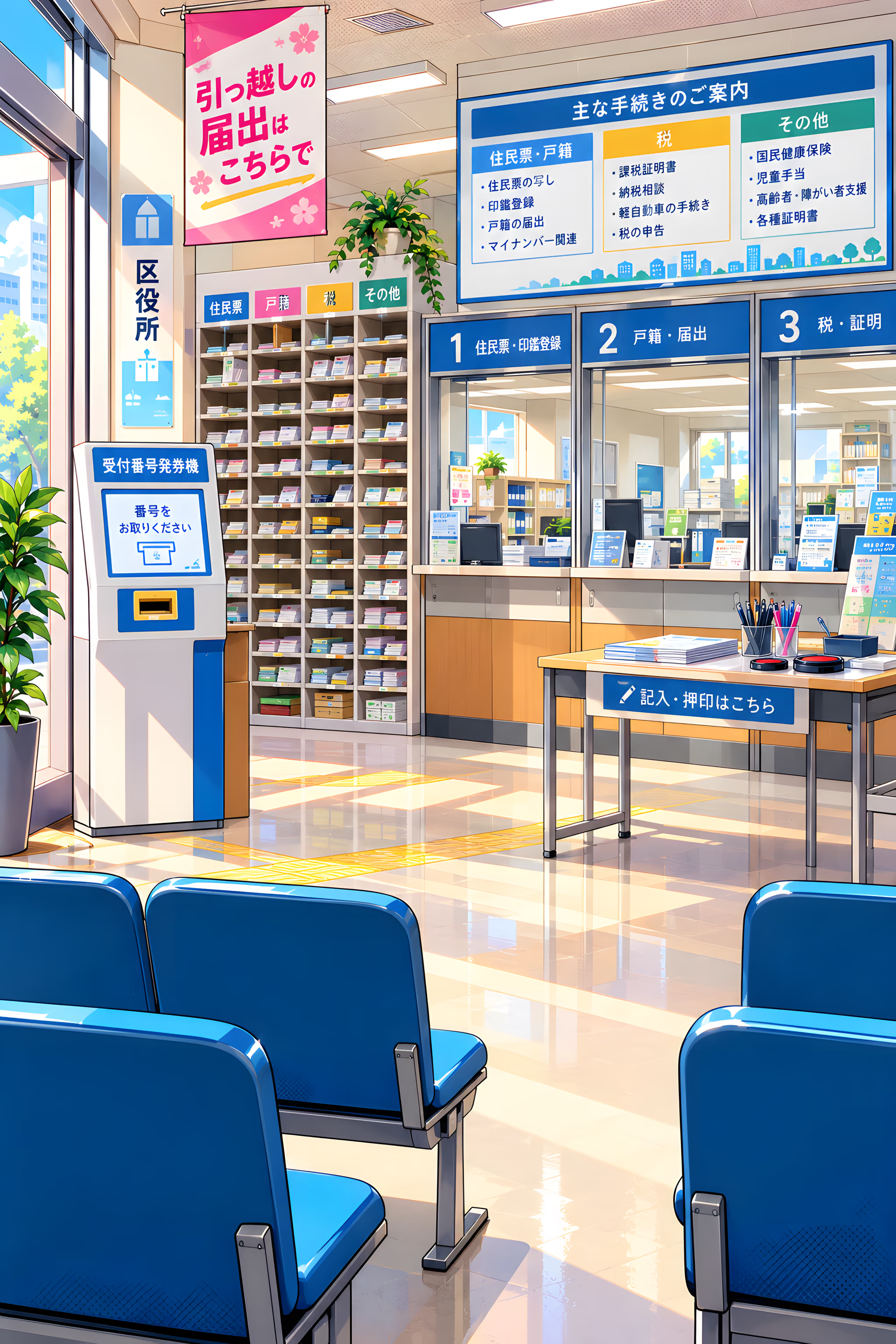

How Yoko opens the conversation
Yoko always speaks first. This is the scene's own opening line, with a reply you could give back at the same level:
転入届の用紙、もらってきましたよ。
Tennyū todoke no yōshi, moratte kimashita yo.
I picked up the moving-in form for you.
You could say
ありがとうございます。何を書きますか?
Arigatō gozaimasu. Nani o kakimasu ka?
Thank you. What do I write?
Other ways it can begin
No two conversations go the same way, and the first line changes too. Each of these can open the scene:
引っ越し、もう慣れましたか。
Hikkoshi, mō naremashita ka.
Have you gotten used to the move yet?
You could say
はい、だいぶ慣れました。
Hai, daibu naremashita.
Yes, pretty much.
この区役所、きれいですね。初めて来ました。
Kono kuyakusho, kirei desu ne. Hajimete kimashita.
This ward office is nice and clean, isn't it? It's my first time here.
You could say
私も初めてです。
Watashi mo hajimete desu.
It's my first time too.
実は私も去年、同じ手続きをしましたよ。
Jitsu wa watashi mo kyonen, onaji tetsuzuki o shimashita yo.
Actually, I did this same paperwork last year.
You could say
じゃあ、安心です。
Jā, anshin desu.
Oh good, that's a relief.
今日は午前中、お休みを取りました。
Kyō wa gozenchū, oyasumi o torimashita.
I took the morning off today.
You could say
ありがとうございます。助かります。
Arigatō gozaimasu. Tasukarimasu.
Thank you. That really helps.
ペン、持ってますか。あそこにもありますよ。
Pen, mottemasu ka. Asoko ni mo arimasu yo.
Do you have a pen? There are some over there, too.
You could say
あ、忘れました。借ります。
A, wasuremashita. Karimasu.
Oh, I forgot mine. I'll borrow one.




Phrases worth knowing here
Lines for what you do at the ward office, each with when you'd say it.
- 転入届を出しに来ました。Tennyū todoke o dashi ni kimashita.I've come to register my new address.Say this first at the counter when your number is called.
- 記入例はありますか。Kinyūrei wa arimasu ka.Is there a filled-in sample form?When you're unsure how to fill in the form and want an example to copy.
- 住民票も二通お願いします。Jūminhyō mo nitsū onegai shimasu.I'd like two copies of my residence certificate as well.Add this while at the counter if you need copies for work or a contract.
- カードの住所変更もできますか。Kādo no jūsho henkō mo dekimasu ka.Can I update the address on my card too?Ask about your My Number or residence card while the clerk has your papers.
- あとどのくらい待ちますか。Ato dono kurai machimasu ka.About how much longer is the wait?Ask staff, or Yoko, while waiting for your number to be called.
Words you'll hear
| Japanese | Romaji | Meaning |
|---|---|---|
| 区役所 | kuyakusho | ward office |
| 転入届 | tennyū todoke | moving-in (address) notification |
| 住民票 | jūminhyō | certificate of residence |
| 窓口 | madoguchi | service counter |
| 番号札 | bangōfuda | numbered ticket |
| 手続き | tetsuzuki | procedure, paperwork |
| 用紙 | yōshi | form, blank sheet |
| 本人確認書類 | honnin kakunin shorui | ID document |
| マイナンバーカード | mainanbā kādo | My Number (ID) card |
| 旧住所 | kyū jūsho | previous address |
How polite to be
polite Here Yoko speaks polite Japanese: です and ます, the way people talk with strangers, neighbors, and coworkers, and the replies suggested to you match the level you'd use back. The guide to keigo explains the three levels, and when each is right.
Try it out loud
In Unsubtitled, Yoko says these lines in their own voice, and answers whatever you say back, typed or dictated, with furigana, romaji, and a translation until you no longer need them.
Start talkingMore scenes with Yoko
- First day at the office陽子(ようこ) · Officepolite
- Planning a trip陽子(ようこ) · Travel agencyformal
- Celebrating a finished project陽子(ようこ) · Izakayacasual
- Opening an account陽子(ようこ) · Bankpolite
- A stain before a meeting陽子(ようこ) · Dry cleanerpolite
- A trip to the dentist陽子(ようこ) · Dental clinicpolite
- Checking in陽子(ようこ) · Airportformal
- A job interview陽子(ようこ) · Interview roomformal
- A hot spring getaway陽子(ようこ) · Hot spring townformal




Or see every scene, with all four characters.